Thursday, August 3, 2017

Exploring Herzegovina

Our next morning dawned early as we had a 7:45 am pick up time for our full day tour of Herzegovina.  But even though it was early, we took the time to pick our clothes carefully as it was the Fourth of July and we wanted to celebrate it somehow even though we were so far from home.  Red, White, and Blue it was...


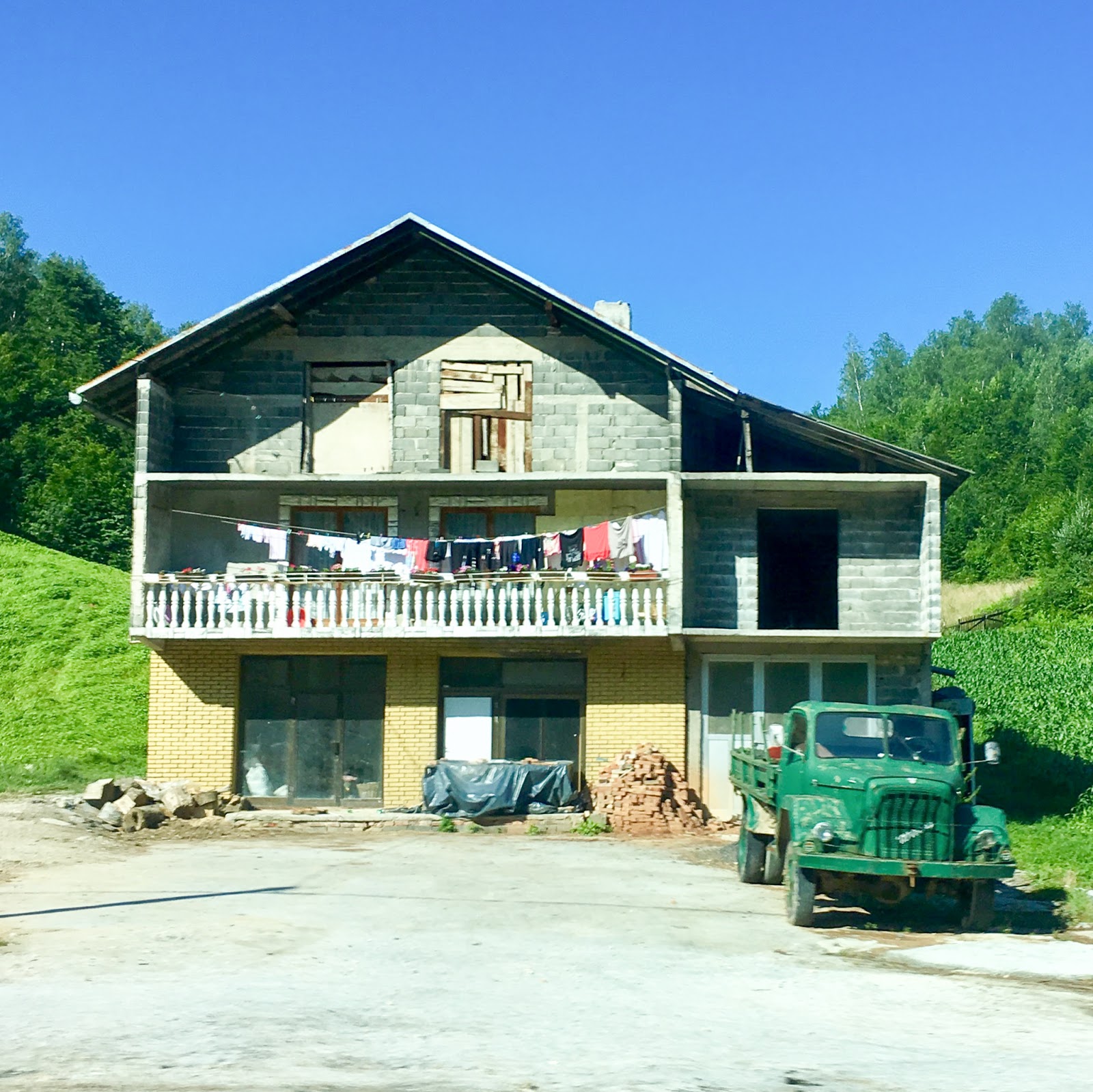
Our driver drove us around the city for a bit as we picked up the rest of our tour guests and I took the time to snap some pictures out the window since up until now I had been driving and not able to sight see.  One thing I noticed immediately was the houses that lined the streets.  They were all different but had one thing in common - they were constructed of brick/mortar blocks and then left that way.  No paint, no sanding, no finishing work at all.  And it wasn't because they were the poorer towns, it was all towns and all styles of house.  Interesting, for sure.


We arrived at our first stop about 40 minutes later.  Settled over 4000 years, the town of Konjic one of the oldest permanent settlements in BiH it is also the place where you can walk from Bosnia into Herzegovina (and vice versa) using the Stara Ćuprija (Old Bridge) though nothing of it is old anymore.  It was originally built in 1682 but was destroyed in WWII by the retreating army and rebuilt in the early 21st century but is still a national monument of BiH.  


Cross that midpoint, and you are in Herzegovina.

Not much else to see in town we mosey on to our next destination - the broken bridge on the Neretva in Jablanica.  Other than being cool to look at...


was also the key piece used in defeating the Axis powers as they tried to advance through Yugoslavia.  I am not going to go into all of the details here but google the Battle of Neretva if you want to know why the maneuver is still taught in military schools around the world.  The short version is that the Yugoslav Partisans, surrounded in this crevice by enemy forces, blew up the bridge to make it look like they were heading in the opposite direction, North.  When the Axis saw this, they headed North giving the Partisans time to repair the bridge (it wasn't totally destroyed) and advance.  It was an actual turning point in the war.

Back on the road again, this time heading about an hour south to the town oPočitelj.  The scenery was gorgeous, and the company was easy, so I sat back and relaxed and enjoyed the fact that someone else was doing the driving.

Počitelj was my favorite stop of the day.  As one of the only urban towns in all of BiH that have been entirely preserved in integrity, from the Medieval/Ottoman periods until today, the place has a charm like no other.  It looks almost exactly as it did back in 1878, when it lost strategic importance to the new rulers, the Austro-Hungarians, essentially freezing it in time.  It is listed on the World Monument Watch as one of the 100 most endangered cultural sites in the world, and I list it as the favorite spot of the day.

The Kula sitting high on the hill overlooking the village.


We climbed up to see the inside of the Hajji Alija mosque which was originally built in the 1500's but destroyed almost entirely in the Bosnian war.  It was rebuilt using the original stone in 2002.


Once again out in the sunshine, we walked up and up again to visit the Kula remains.
And then we climbed again to get to the top of the silo tower to see the best views of the town below.


At this point, it was time to get some lunch.  We all headed back to the van, and our guide drove us about 20 minutes to a very remote spot in what seemed like the middle of nowhere.  We were there to have lunch at a gorgeous place right on the water -

Our view from lunch.

The main reason we were stopping at this particular restaurant was actually the white house you see on the left top of the picture above.  Named the Blagaj Tekke (Dervish House), the house was built in 1520 the house is a national monument and is still a place of worship for the Dervish cult.  The Dervish also called the Whirling Dervish due to their tendency to twirl in circles when praying, believe in the universal values of love and service.


Once again back in the van, we drove north about 1/2 hour to the main attraction of the day, Mostar, and its famous bridge.  The Stari Most (Old Bridge) was considered a feat of engineering when it was built in the 1500's.  Legend has it that the architect was commissioned to build a bridge of unprecedented dimensions and he did just that by constructing the worlds largest free standing arch.  Legend also has it that he prepared his own funeral for the day of the unveiling because he was sure that it would collapse.  It did not, and in fact, it stood for 427 years until it was destroyed in the Bosnian war in November of 1993.  Rebuilt in 2004 the bridge is now a UNESCO Heritage Site and a place that the daring dive from into the river below. (Unfortunately, we got there too late to see the divers).


We had ice cream on the banks of the river - and even got to pet a turtle...


Mostar was our final stop for the day.  Thankfully.  Because it was now after 7 pm and we had almost a 2-hour drive home.  It was a fabulous day exploring but we weren't done yet for the next day we were off to Split.


Monday, July 24, 2017

Scars of Sarajevo

On April 5, 1992, Bosnian Serbs, looking to create a new state of Republic Srpska, encircled the hills that surrounded the city of Sarajevo with 13,000 troops and laid seige to the land below.  For 1425 days they shelled and shot and assaulted the buildings and people below.  Neither side showed any mercy and when the war finally ended, 13,952 people were dead.  40% of them were civilians.

It has been just over 21 years since the final shot was fired.  And in those years there has been a lot of rebuilding. But for every bright and shiny new high rise, there are many, many more buildings that still bear the scars of war.  Everywhere we walked we saw bullet holes, and mortar shell scars and broken or boarded windows...


Under our feet, we saw far too many of these...


The Sarajevo Roses.  The mortar shell leaves a unique fragmentation pattern when it explodes, almost in the pattern of a rose.  During the siege, thousands of mortar shells were exploded and left marks very unique to the city.  The mortar shells that killed one or more persons were filled with a red resin as a memorial.  There are fewer and fewer of them each year as the concrete is replaced.

Some buildings bore their scars in a more modern way - they put plaques of the persons who lived in the building who were killed during the war...


But the most obvious scars of the war are the white graves, standing tall and straight, in all areas of the city, bearing witness to the inhumanity of what happened here.


Friday, July 21, 2017

Sarajevo

If you had asked me while I was in my early twenties if I could ever see myself on vacation in Bosnia and Herzegovina, specifically Sarajevo, I would have emphatically said no, for obvious reasons.  The city had just declared its independence from Yugoslavia, and the Bosnian War for Independence began almost immediately.  For 1425 days, the city was destroyed bullet by bullet, and its citizens lived in fear for their lives.  Needless to say, it was not a vacation spot.  But even though Sarajevo has a complicated recent past it also has an incredible history, and we just couldn't pass up spending a couple of days in the country to see it for ourselves and hear its stories firsthand.

Getting there was not easy.  It is only 250 km from Zagreb to Sarajevo, but it would take us over 5 hours to get there.  If you do the math that is an average speed of 40 km/hour (or about 25 mph).  Partly because there is only one true road way in that is two lanes the entire way and goes through every small town between the two locations and partly because our GPS has limited information on BiH.  But we made it in time to have dinner at a fantastic restaurant recommended to us by our guide from the truffle hunt the night before, who is from Sarajevo.

The next morning we had a half day walking tour.  We didn't want to attempt to just wing it in a town this rich in history and so full of nuance.  Because the city is so compact, the walking tour made it easy for us to get the highlights during our 4 hours and then we could head back and get deeper into the details on our own later in the day.

We started the tour at one of the most famous spots in all of Sarajevo - the corner across from the Latin Bridge.  In the photo below, where it now says Museum, used to be a deli.  The deli that Gavrilo Princip sat in drinking coffee, thinking he had missed his chance to assassinate Archduke Franz Ferdinand when Ferdinand's car suddenly appeared before him after making a wrong turn down the very street Princip was standing on.  Princip shot twice, the first bullet mortally wounding Ferdinand and the second his wife, Sophie.  And that was the beginning of World War I.


We then walked across the bridge and heard the same story we had read the night before at dinner since this was the restaurant we ate at.  Inat kuća (the House of Spite) is so named because after the Austro-Hungarian empire took over Bosnia they wanted to build the city up.  They established a National Museum, a Post office, and a Law building but when they went to build the City Hall, they found a house owned by an old man in the spot they had selected.  Offering the old man money to demolish his home did nothing but make him stubborn about not selling his home and land.  He said the house was his inner peace.  Finally, the old man stated that they could have the land if they gave him a bag of gold coins AND moved his house brick by brick to the other side of the river.  The old man got his way, and the house is now a restaurant that serves the most delicious Bosnian food and represents the stubborn constitution of the Bosnian man.


Right across the street is the National and University Library of Bosnia and Herzegovina.  Almost completely destroyed in the shelling of August 1992, many historical documents were lost forever.

Just around the corner, we took some time to wander through Baščaršija - the bazaar and the cultural center of the city - and take a look at their traditional offerings.  Including many, many souvenirs made, ironically, from the very bullets that killed so many of their people.


Bullet pens, bottle openers, and whistles.

We kept right on going as our tour did not have time built in for shopping and ended up at the Gazi Husrev-beg Mosque.  It is one of the most representative Ottoman structures in the Balkans and the largest historical mosque in BiH.  Built in the 16th century, the mosque now serves as the main congregational mosque in Sarajevo.


On to the Old Jewish Synagogue - which has been built and destroyed consistently by war since the 16th century -


and around the corner once again to the Sarajevo Cathedral (you can see why they call Sarajevo the Jerusalem of Europe)

The cathedral and the statue of Pope John Paul.

We saw the eternal flame memorializing the victims of WWII.


And we ended our tour at the Pigeon statue where the old men play chess, and you have fantastic views of yet another church, this one the Orthodox Sacred Heart Cathedral.


By now we had the lay of the land and were getting a bit hungry, so we said many thanks to our tour guide and straight to the Sarajevo Brewery for some lunch and local beer.


Ice cream was then in order so back to the bazaar for some gelato...


Fortified with food and drink, we started the trek up the hill to the Yellow Fortress which used to be a bastion in the fortified wall that protected the city but since the dawn of the Austro-Hungarian's empire in BiH, it is basically just a place to grab coffee and see the fantastic view of the city.


We decided to forgo the street climb so we could walk up through the cemetery that is home to a small fraction of the victims of the recent war.  It was all at once heartbreaking and disconcerting because so many of the tombstones had birth dates very close to my own.


 The top!

We found a table and enjoyed the view.  We also had to try the Bosnian coffee we had heard so much about.  And that included the girls who begged to taste.  And we did it the Bosnian way - first put the sugar cube in your mouth, then take a sip of coffee and let the sugar mix with the grainy, very thick and bitter coffee...


She smiled but didn't want any more.

She plain just didn't like it.  And I was with her.  Too potent and too many grounds for my taste.


Back down in the city center, we decided to let the spinner on the dividing line between the East and West choose which way we explored next.

It chose East, though we didn't listen to it in the end as we really wanted to visit Gallery 11/07/1995, which was in the West.  The gallery is an exhibition of photographs (the first of its kind) the memorializes the Srebrenica tragedy and the 8372 persons who perished in the genocide.  It is haunting and compelling and horrifying and not something any of us will forget anytime soon.

A partial list of names of the victims.


We spent almost 90 minutes in the small room, watching movies, reading literature and studying the photos.  And after that, we all decided we could use a bit of levity and fun, so we walked to the area we would have dinner and just let the girls goof around.  They earned it after such a full day of exploring.


And with that we called it a day.  We had an early wake up call in the morning after all.  Herzegovina was calling our names.